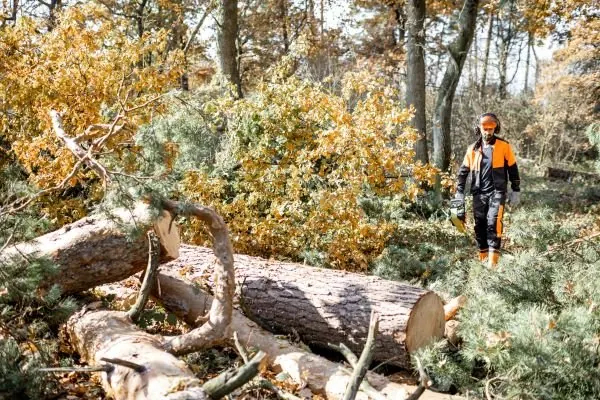
When removal is the honest answer
Most trees are worth keeping. On the Central Coast they shade the house through humid summers, hold soil on sloping blocks and give birds and gliders somewhere to live. But some trees reach a point where no amount of pruning makes them safe or practical, and then removal is the straight answer.
The common reasons people call us about tree removal:
- The tree is dead or dying. Dead eucalypts dry out and become brittle, and the longer they stand the harder they are to climb safely. Dieback in the crown, peeling dead bark and fungal growth at the base are all worth getting looked at.
- A new lean. A tree that has always leaned is often fine. A lean that appeared after heavy rain, with cracked or raised soil on one side, is not. Saturated sandy and clay soils both lose grip in long wet spells.
- A split trunk or fork. Tight V-shaped forks with bark trapped between the stems are a known weak point in gums and angophoras.
- Wrong tree, wrong spot. Too close to the house, lifting a driveway, pushing over a retaining wall, or standing where a pool, granny flat or extension is going.
- Repeated limb drop. Some trees shed heavy branches onto roofs, cars and play areas year after year.
- Weeds. Camphor laurel, privet and other weedy trees that spread into nearby bushland and take over a garden.
How removals are done on Central Coast blocks
The method depends on the space around the tree, and on this coast space is often the problem.
Straight fell. Only where there is a clear, flat landing area at least as long as the tree, with nothing to hit. On suburban blocks that is unusual.
Sectional climb. The most common method near houses. A climber works down the tree, cutting it into manageable sections that are lowered on ropes through a pulley system. It is slower, but nothing is dropped where it should not be.
Elevated work platform. Where a truck-mounted or tracked platform can reach the tree, the operator cuts from a basket. It is quick on accessible blocks, but sloping driveways and soft lawns often rule it out.
Crane-assisted removal. For very large trees over houses, or on steep blocks where nothing can be lowered safely, a crane lifts each section clear. It adds cost but can save a lot of time and risk.
On escarpment and hillside lots the job does not end when the wood is on the ground. Every piece has to get back up to the street, sometimes up stairs or along a narrow side path. That handling is a real part of the price, and a good quote will say how it is being done.
Approvals: check before anything is cut
Tree rules on the Central Coast come from more than one place.
Central Coast Council regulates the removal and pruning of many trees on private land through its planning controls. Some trees can be removed without approval, others need a permit, and some work needs development consent. The rules can also differ for heritage items, trees near waterways and land with environmental zoning.
The NSW 10/50 vegetation clearing code, run by the NSW Rural Fire Service, lets owners of land in a mapped entitlement area clear trees within 10 metres of a home without Council approval, as long as the code's conditions are followed. Our 10/50 guide explains how it works.
Native wildlife. Large old trees can have hollows used by birds, possums and gliders. The contractor should check for occupied hollows and nests before cutting, and it is worth asking how they handle it.
If you are not sure, ask the contractor to help you check with Council before work starts. It is far easier than explaining a removal afterwards.
Getting the property ready
A few things make removal day go smoothly:
- Move cars, trailers, boats and outdoor furniture away from the work area.
- Keep pets inside and let neighbours know if branches overhang their side.
- Clear a path from the street to the tree if you can, and unlock gates.
- Point out irrigation lines, septic systems, pool equipment and underground services near the tree.
- Mention the power line to the house. Trees near live lines need someone authorised to work near them.
What happens to the wood
Branches are normally chipped on site. Logs are cut into rounds and removed, or left stacked if you want firewood. If you would like the mulch for garden beds, say so when you book. On bushfire-prone blocks it is worth keeping big piles of mulch and dry debris away from the house.
After the tree is gone
You will be left with a low stump unless you have asked for it to be ground out. Grinding is quick and leaves a hole filled with chips that you can top with soil and turf. If you are building over the spot, full stump and root extraction may be needed instead; see stump grinding.
If you are unsure whether you need removal at all, ask about lopping or pruning first. A good contractor will tell you if a tree can be kept.