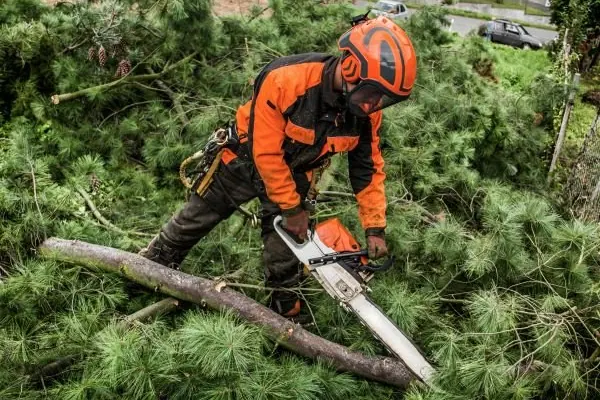
What tree lopping means here
On the Central Coast "tree lopping" usually means reducing the size of a tree that has become too big for where it stands: a blackbutt that now towers over a single-storey house, a spotted gum whose limbs reach across the roof, a row of camphor laurels that block the afternoon sun.
The aim is a smaller tree that is still healthy and still looks like a tree. That takes judgement about where each cut goes, and it is why we ask the contractors we work with to cut back to sound points instead of flat-topping.
Good lopping and bad lopping
Good lopping takes a branch back to a union, the point where it meets a smaller branch heading in roughly the same direction. That smaller branch takes over as the new tip. The wound sits where the tree can seal it off, and the canopy keeps a natural shape.
Topping cuts straight across branches at an arbitrary height, leaving stubs. The tree responds with dense clusters of fast, weakly attached shoots, the stubs often decay, and within a few years the tree can be as tall as before and more likely to drop limbs. On eucalypts in particular, those epicormic shoots can grow quickly and break in storms.
If a quote promises to "take the top off" without saying where the cuts will be made, ask more questions.
Trees we are often asked to lop
- Tall eucalypts over houses. Blackbutt, spotted gum and planted gums that have grown well above the roof line.
- Angophoras leaning toward a view. The twisting limbs of smooth-barked apples often grow out over driveways or toward water views.
- Hedging trees gone wild. Lilly pilly, murraya and conifer screens that have shot up past the second storey.
- Exotics shading the garden. Camphor laurel, jacaranda and coral trees that now shade solar panels, pools or vegetable gardens.
- Trees near the service line. Branches reaching toward the power line from the street to the house.
When lopping is not the right job
Sometimes lopping is the wrong fix:
- A dead or structurally failing tree. Taking the top off a tree with a rotten base or a split trunk does not make it safe. That is a tree removal.
- Branch clearance only. If the problem is a few branches over the gutter, selective pruning is gentler and usually cheaper.
- Very large reductions. Taking most of the canopy off a mature tree can kill it slowly. A contractor may suggest removal and replanting instead.
Council rules and lopping
Central Coast Council's tree controls cover pruning as well as removal for many trees. Heavy reductions are often treated much like removal and may need approval first, while light maintenance pruning can be treated differently. Waterfront land, heritage items and properties with environmental zoning can carry extra conditions.
On mapped bushfire-prone land, the NSW 10/50 code lets owners do certain clearing near a home without Council approval, within strict conditions. See the 10/50 clearing rule guide.
The simplest approach is to describe the work you want to Council, or have the contractor do it, before the job is booked.
How a lopping job runs
- Look at the tree. The contractor checks the species, its health, the structure of the canopy and what is underneath.
- Agree the reduction. You agree which parts of the tree come back and by about how much. Photos with the branches marked can help.
- Rig and cut. Most lopping is done by climbing, with heavier limbs lowered on ropes to protect roofs and gardens. Where a platform can reach, it may be used instead.
- Chip and clean. Branches are chipped, logs removed or stacked, gutters and lawns cleared.
Timing
Most trees can be lopped at any time of year, though some do better outside periods of heavy growth or drought stress. If birds are nesting, the contractor may suggest waiting. After a reduction, plan to have the tree looked at again in a few years; regrowth is normal and is easier to manage early.
For rough costs, the tree removal cost guide includes lopping and pruning ranges.