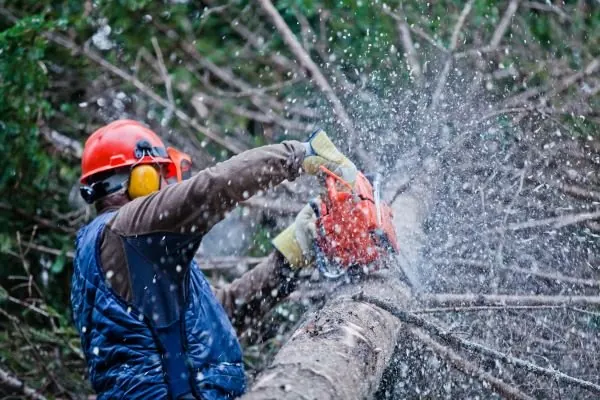
First things first: safety
Storms on the Central Coast come in two main forms: summer thunderstorms with sudden squalls, and east coast lows that bring days of heavy rain and strong winds off the ocean. Both bring trees down. Saturated soils on sandy flats and clay slopes let whole trees topple, and heavy limbs on eucalypts and angophoras can fail even in moderate winds once they are wet and weighed down.
If a tree or large limb has come down:
- Get people clear. Out of damaged rooms, away from the tree and anything it is resting on.
- Look for wires. Assume any fallen line is live. Stay at least eight metres away and call Ausgrid on 13 13 88. Keep others back too.
- Call for emergency help if needed. For life-threatening situations call 000. For storm and flood help, such as a damaged roof, the NSW SES is on 132 500.
- Take photos. Before anything is moved, photograph the tree, the damage and the wider scene for your insurer.
- Call your insurer. Many insurers have a process for storm claims and may want to approve work first.
- Then call us on (02) 4307 6753 to arrange a contractor to make safe and clear.
What "make safe" means
Making safe is not the same as a full clean-up. The first job is to remove the immediate danger:
- Taking weight off a roof, fence, carport or car in a controlled way
- Cutting away hung-up limbs caught in other trees
- Lowering or dropping any remaining parts of the tree that are likely to fail
- Clearing a path so people and vehicles can get in and out
Storm-damaged wood is often under tension or compression, which makes it unpredictable to cut. A trunk bent under the weight of another tree can spring when released. This is skilled work, and it is often slower and more careful than a normal removal.
Once the site is safe, the rest of the clean-up can be done: chipping branches, cutting and removing logs, grinding the stump and tidying the yard.
After the storm: checking the trees that stayed up
Trees that survived can still be damaged. Look for:
- New leans, especially with cracked or lifted soil around the base
- Split trunks or forks, particularly in trees with tight V-shaped unions
- Hanging branches caught in the canopy
- Torn bark or exposed wood where a limb has broken away
- Roots exposed after soil washed away on slopes
Damaged trees may need pruning to remove broken limbs, or removal if the damage is too severe.
Approvals after a storm
In genuine emergencies where a tree poses an immediate risk to life or property, the rules can allow urgent work before the usual approvals. The details depend on the circumstances and on Central Coast Council's controls. Keep photos and records of the damage and the risk, and check with Council about any paperwork needed afterwards. Do not use a storm as a reason to remove undamaged protected trees.
Insurance
Policies vary a lot. Many cover the cost of removing a tree that has hit the house or another insured structure, but not always the cost of removing a tree that fell in an open part of the yard. Some cover only the part of the tree touching the building. Before work starts:
- Take clear photos of the damage
- Ask the insurer whether they need to approve the contractor or the quote
- Ask for a written quote and invoice that describe the work, which insurers usually want
Preparing before the next storm
The best storm work happens before the storm. Ahead of the wetter months, consider having large trees near the house checked for dead wood, weak forks and branches over the roof. Gutters cleared of leaves and bark also reduce water damage and, on bushfire-prone land, fire risk.
For an idea of what a make-safe or clean-up might cost, see the cost guide. Every storm job is different, and the real price comes from a site look.